









Table of Contents:
- Key statistics on skin cancer
- Understanding UV rays
- The main types of skin cancer
- Risk factors and key data
- Prevention: protecting children's skin from an early age
- Conclusion
Skin cancer is the most common cancer worldwide. In Europe, more than 2 million cases are diagnosed each year, and this figure continues to rise. UV rays are responsible for the majority of skin damage, and even short but intense exposure can weaken the skin, cause burns, and create lesions that may promote the development of cancer.
Key statistics on skin cancer
- Just one severe sunburn before the age of 18 doubles the risk of melanoma (source: La Ligue contre le cancer)
- 50% of the loss of "sun capital" (the skin's ability to defend itself from the sun) occurs during childhood.
- 80% of a lifetime's sun exposure occurs before the age of 18
- 50 to 90% of skin cancers are linked to UV rays (source: WHO)
- The incidence of melanoma has doubled in Europe over the last 30 years (1985-2015).
These figures show that protecting the skin from an early age is crucial for preventing cancer.
Understanding UV rays
UV rays are divided into two main types:
- UVB rays, which are responsible for burns and direct damage to skin cell DNA, a key factor in the development of cancer.
- UVA rays, which penetrate deeper into the skin, accelerate skin aging, and indirectly contribute to the risk of cancer.
Even on cloudy days, up to 80% of UV rays pass through the clouds and affect the skin, which highlights the importance of systematic protection, especially for children.
The main types of skin cancer
There are several forms of skin cancer:
- Basal cell carcinoma: the most common type, it develops slowly and is generally treated effectively.
- Squamous cell carcinoma: can progress more rapidly and is often found on sun-exposed areas.
- Melanoma: rarer but much more dangerous, it can appear after intense UV exposure and is strongly linked to sunburns suffered in childhood.
The most affected areas are the face, neck, torso, and arms, but cancer can develop on any part of the skin.
Risk factors and key data
Several factors increase the risk of skin cancer:
- Fair skin, blond or red hair, light eyes.
- Excessive UV exposure from childhood. Family history of skin cancer.
- Multiple sunburns during childhood.
According to the World Health Organization (WHO), about 90% of skin cancers are linked to exposure to UV rays. This means that the majority of these cancers can be avoided with adequate protection from the first years of life.
Prevention: protecting children's skin from an early age
The good news is that prevention is simple and very effective. For children, whose skin is particularly fragile, it is essential to combine several protective solutions:
Sunscreen and SPF
Sunscreen is a pillar of UV protection. For young children, an SPF of 50 or higher is recommended. Apply generously to all exposed areas: face, neck, arms, legs, ears, and hands. Reapply every two hours, or after swimming or sweating. Even if clothing covers part of the body, some areas remain vulnerable, and sunscreen completes the protection.
UPF50 clothing: the physical barrier
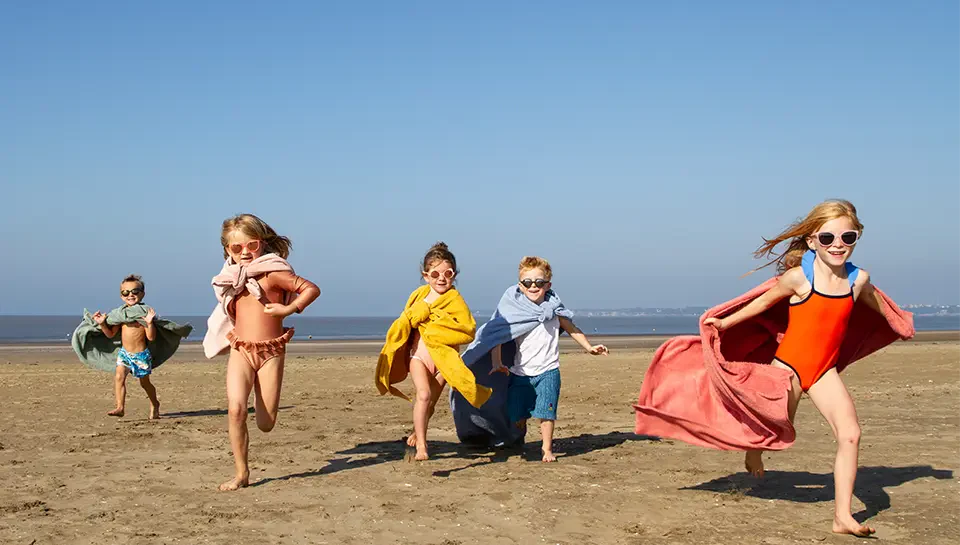
Clothing with UPF50 protection blocks more than 98% of UV rays, offering constant protection. Long-sleeved t-shirts, light pants, sunsuits, and UPF50 swimsuits allow children to enjoy the sun while limiting the risk of burns and cancer. Unlike sunscreen, this protection does not require reapplication and is resistant to sweating and swimming.

Hats and sunglasses
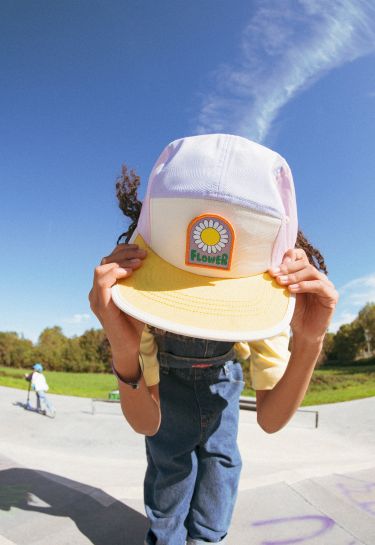
Complete protection must include a wide-brimmed hat and anti-UV sunglasses. The face, eyes, and ears are particularly sensitive to UV rays. Covering hats and appropriate sunglasses reduce UV exposure, protect children's fragile skin, and limit premature aging. Sunglasses also help prevent UV-related eye damage, which can appear very early.
Habits to adopt from an early age
To make protection become natural:
- Avoid exposure between 12 p.m. and 4 p.m., when UV rays are at their most intense.
- Dress children in UPF50 clothing, hats, and sunglasses every time they go out.
- Apply SPF to all uncovered areas.
- Explain to children why these steps are important for their skin so that they adopt them naturally.
- Favor shaded areas and protected activities during periods of high exposure.
These simple measures significantly reduce the risk of cancer and protect children's skin for life.
Conclusion
Skin cancer can affect anyone, but it is largely preventable. The data shows that UV exposure from childhood is a determining factor in cancer risk, which makes prevention essential. By combining SPF 50 sunscreen, UPF50 clothing, hats, and sunglasses, you ensure complete skin protection.
Adopting these habits early helps to limit UV exposure, reduce the risk of burns and cancer, and offer children healthy skin for their future.
Investing in skin protection from an early age is an investment in their long-term health.