






Summary:
- Why the right size of sunglasses changes everything
- How to measure a child's face width?
- Age, face shape, bridge, temples: the details that matter
- What about Ki ET LA frames?
- Ki ET LA sunglasses size guide
- FAQ: how to choose the right size of sunglasses for a child?
Choosing children's sunglasses is not just about age or style. To keep up with little adventurers on all their sunny outings, sunglasses need to be the right size: a frame adapted to the width of the face, lenses that provide good coverage, a stable bridge on the nose, and comfortable temples.
Good news: with a measuring tape and two minutes flat, you can easily measure your child's face and find the ideal size of sunglasses, without turning your living room into an optician's store.
Key takeaways
- Measure your child's temporal span: the face width between the two temples
- Refer to the Ki ET LA size guide, based on the desired sunglasses model and your child's age
- If in doubt between two sizes, always choose the larger size
- For ages 0-4, the adjustable strap helps keep the sunglasses securely in place
Why the right size of sunglasses changes everything
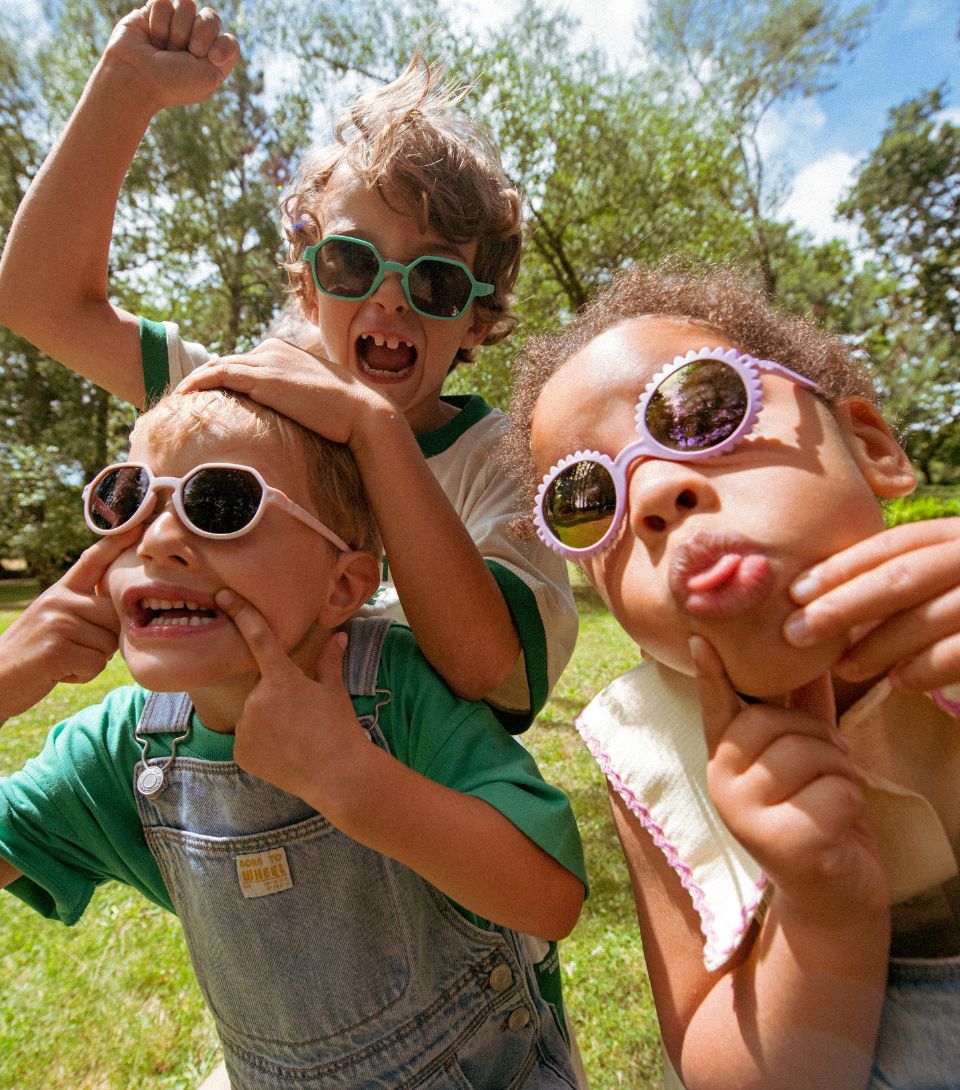
A pair that is too big slides off; a pair that is too small presses against the temples: in both cases, the child is likely to take them off. However, to protect their eyes, sunglasses must stay well-positioned on the face, with covering lenses and a comfortable frame.
A child moves, runs, climbs, looks up, looks down, everywhere except where you thought they would. The right size of sunglasses is obviously one that stays securely on the face, protects the eyes properly, and lets the child move, run, and play without being bothered.
To choose a pair of sunglasses correctly, consider:
- Your child's age, which is a useful first reference point
- The width of their face, measured between the two temples
- The shape of their nose, so that the bridge of the glasses rests well without sliding
- The length of the temples, which should hold the glasses without squeezing
- The lens coverage, to correctly protect their eyes from the sun
For toddlers, a pair of baby sunglasses must take into account the lack of a defined nasal bridge. Rounded shapes and frames designed for small faces are particularly recommended.
Good to know
For all Ki ET LA collections up to 4 years old, an adjustable strap is provided with the sunglasses. It is practical for helping the frame stay in place on toddlers' faces, even when they are moving, running, and exploring... In short, when they are living their best kid life.
How to measure a child's face width?
The most important measurement is the temporal span. This is the width of the face between the two temples, expressed in millimeters. It allows you to choose a sunglasses size that is consistent with the actual shape of your child's face, beyond their age.
The measuring tape method:
Sit your child up straight, facing you. With a flexible measuring tape, measure the distance between the left temple and the right temple, at the point where the temples of the glasses will be positioned. Note the result in millimeters. For example, if you get 104 mm, you can look for a size corresponding to this temporal span.
The printable template method:
You can also use a printable fitting guide: you cut it out, test it on the face, and voilà, you check if the frame fits well.
Our advice
If you are hesitant or if your measurement falls between two sizes, always take the larger one. It is better to have a frame that allows for a little growth than a pair of glasses that is already too tight.
Age, face shape, bridge, temples: the details that matter
Your child's age provides a first reference, but it does not replace measurement. Two 2-year-olds can have different face widths. That is why the temporal span in millimeters remains your best ally for choosing the right size of sunglasses.
The bridge is also important: it must rest correctly on the nose without sliding. For a baby or young child, an adapted shape prevents the glasses from sliding down too low. The temples should follow the head without pressure. A good length allows for comfortable support, especially when the child is also wearing a cap, hat, or helmet.
Did you know?
Water, sand, and snow reflect UV rays. To properly protect children's fragile eyes, opt for well-fitted sunglasses with lenses that provide adequate coverage. The perfect combo: a hat, anti-UV swimsuit, and sunscreen suited for exposed areas.
What about Ki ET LA frames?
At Ki ET LA, collections are designed to accompany children according to their age and activities. The Fun models are aimed at 0-4 year olds, with frames adapted for early years. The Vibe models target 4-12 year olds, with a bolder style. The Iconik models cover a wide range from 0 to 12 years depending on the reference.
Some frames for younger children are designed with mono-injection, without hinges or screws, to limit detachable parts and provide flexibility and comfort.
Ki ET LA also offers sunglasses made in France in some collections, with a focus on protection, comfort, and style.
Ki ET LA sunglasses size guide
Here is the guide to refer to for choosing the right size according to the collection, the sunglasses model, the age, and your child's temporal span:
Temporal span expressed in millimeters
| Collection | Model | 0-1 year | 1-2 years | 2-4 years |
|---|---|---|---|---|
| fun 0-4 years |
FLEUR | 98 | 103 | 108 |
| OURSON | 95 | 104 | 110 | |
| LION | 94 | 105 | 110 |
| Collection | Model | 4-7 years | 7-12 years |
|---|---|---|---|
| VIBE 4-12 years |
POP | 111 | 116 |
| URBAN | 115 | 125 |
| Collection | Model | 0-1 year | 1-2 years | 2-4 years | 4-6 years | 4-7 years | 6-9 years | 7-12 years |
|---|---|---|---|---|---|---|---|---|
| ICONIK 0-12 years |
DIABOLA | 100 | - | - | - | - | - | - |
| WAZZ | 93 | 99 | 104 | - | 113 | - | 118 | |
| OOZZ | 95 | 100 | 104 | - | - | - | - | |
| EYZZ | - | - | - | - | 113 | - | 121 | |
| ROZZ | - | 104 | 111 | 118 | - | 126 | - | |
| BUZZ | - | - | - | 123 | - | 129 | - |
| Collection | Model | 0-2 years | 2-4 years | 4-6 years | 6-16 years | Adult |
|---|---|---|---|---|---|---|
| WOAM 0 - Adult |
WOAM | 100 | 103 | 106 | 118 | 132 |
FAQ: how to choose the right size of sunglasses for a child?
How to measure the width of their face?
Measure the distance between the two temples with a flexible measuring tape. This width corresponds to the temporal span, expressed in millimeters.
What is the difference between sunglasses sizes for adults and children?
Children's sizes are adapted to a smaller face: reduced width, adjusted bridge, shorter temples, and frames designed to provide better eye coverage.
What are the criteria to consider when choosing children's sunglasses?
The right criteria: a frame adapted to the child's age and face shape, comfortable temples, lenses with good coverage, and effective UV protection.
How do I know if I am choosing the right size of sunglasses online?
Measure the temporal span, compare it to the table in millimeters, and if in doubt between two sizes, choose the larger size.