




Table of Contents:
- The fragility of children's eyes against UV rays
- The benefits of sunglasses for children
- How to choose the right sunglasses for children?
- Situations where wearing sunglasses is particularly recommended
The sunny days are back, and with them, the sunlight that does so much good for our mood. But while parents instinctively think of sunscreen to protect their children's skin, they often forget an essential point: eyes are also fragile when exposed to sunlight. Wearing suitable sunglasses from a very young age is not just a fashion statement, but a true health measure.
The fragility of children's eyes against UV rays
The role of the lens and eye anatomy
In children, the eye is still in full development. The crystalline lens, this small natural lens responsible for filtering light, is not yet fully formed. The result: it lets a large portion of ultraviolet (UV) rays pass through to the retina.
Studies show that a child under 10 years old lets up to 75% of UV rays reach their retina, compared to barely 10% in adults. These invisible rays can permanently damage ocular tissues and therefore our children's health. Thus, to avoid this, it is important to adopt sun protection from a very young age.
Vulnerability to UVA and UVB rays
The sun emits two types of dangerous rays:
- UVA rays, which penetrate deep into the eye and accelerate cell aging.
- UVB rays, which are more energetic and responsible for direct damage like corneal sunburns.
In children, the cornea and crystalline lens still filter these rays very little, which makes their eyes much more vulnerable. Unlike skin, the eye does not "tan" to defend itself: the damage from the sun is invisible, yet very real.
Short-term risks
Too much intense exposure without protection can cause:
-
significant glare, hindering vision and causing headaches,
-
photokeratitis, which is a type of sunburn on the cornea that is painful and very uncomfortable,
-
irritation or a sensation of sand in the eyes.
These symptoms can appear just a few hours after being in the sun without sunglasses.
The importance of protection from a very young age
We often talk about the sun capital for the skin, but it also exists for the eyes!
Before age 10, children's crystalline lenses let in many more UV rays than adults', which makes their eyes particularly vulnerable. Each exposure leaves a mark, and these effects are cumulative over time.
Protecting children's eyes therefore means preserving their sight for the future. A pair of suitable sunglasses must quickly become an essential reflex — just as important as sunscreen for the skin.
Long-term risks
The consequences of prolonged exposure without protection can appear many years later:
-
early cataract, due to clouding of the lens,
-
macular degeneration, which impairs central vision,
-
pterygium, a small growth on the cornea linked to repeated sun exposure.
In short, ocular sun protection is a true long-term preventative measure.
The benefits of sunglasses for children

Complete protection against UVA and UVB rays
Quality sunglasses for children are designed to block 100% of UVA and UVB rays.
The "UV400" marking guarantees total protection against harmful rays, even on cloudy days.
At Ki ET LA, all glasses are certified to the EN ISO 12312-1 standard and tested to ensure maximum safety without compromising on comfort.
Glare reduction
Tinted or polarized lenses reduce unpleasant reflections, especially at the beach, in the mountains, or in the car.
The child maintains clear and sharp vision without constantly squinting. Result: more comfort, less eye fatigue, and true enjoyment of the great outdoors.
Prevention of eye damage
Sunglasses for children are not just a fashion accessory: they act as a real protective barrier. By filtering 100% of UVA and UVB rays, they prevent UVs from reaching the cornea and the retina, two very sensitive areas essential for vision.
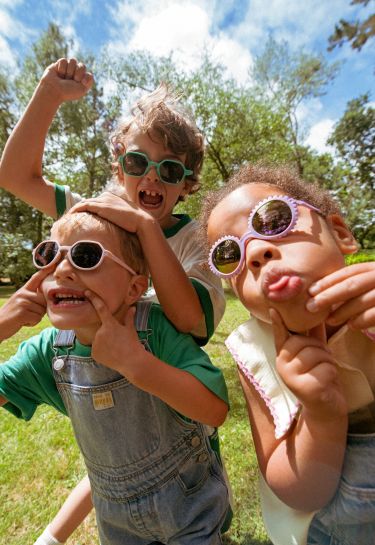
But protection doesn't stop there. Outdoors, they also serve as a physical shield against wind, dust, sand, or even small insects. They limit irritation, redness, and stinging sensations, especially for children who play outside, run, dig, or roll in the grass.
At the park, on the beach, on vacation, or during sports activities, a good pair of glasses becomes an indispensable everyday ally. In addition to protecting their ocular health, they allow children to enjoy the outdoors without discomfort or overly intense light.
How to choose the right sunglasses for children?
Where to find quality glasses and how to check their effectiveness?
Always prioritize specialized retailers or recognized brands that respect European safety standards. Beware of novelty models sold at markets or online without certification: they may look pretty, but they do not filter UV rays correctly.
Quality criteria
-
CE marking: mandatory to guarantee compliance.
-
EN ISO 12312-1 standard: proof that the lenses filter 100% of UV rays.
-
Protection rating: choose category 3 lenses, perfect for high light intensity.
At Ki ET LA, we guarantee that all these criteria are met for our baby sunglasses and our children's glasses.
Materials
The majority of Ki ET LA frames are made of mono-injection (TPEE), which makes them unbreakable, flexible, and resistant to drops, even when children are constantly moving. They are designed not to hurt the face and include temples that compress without breaking, ensuring comfort and safety. Furthermore, they are lightweight and comfortable to wear all day long, so children forget they are even on their nose!
Size and fit
An effective pair of glasses must cover the face well and remain stable, without sliding. A poorly adjusted frame lets rays pass through the sides, reducing the effectiveness of the protection. Our models are designed to adapt to the child's facial structure, with a perfect hold on the nose and behind the ears, from a very young age. Additionally, for the 0-4 age models, we provide a strap to keep them securely in place.
Design: encouraging children to choose glasses they like
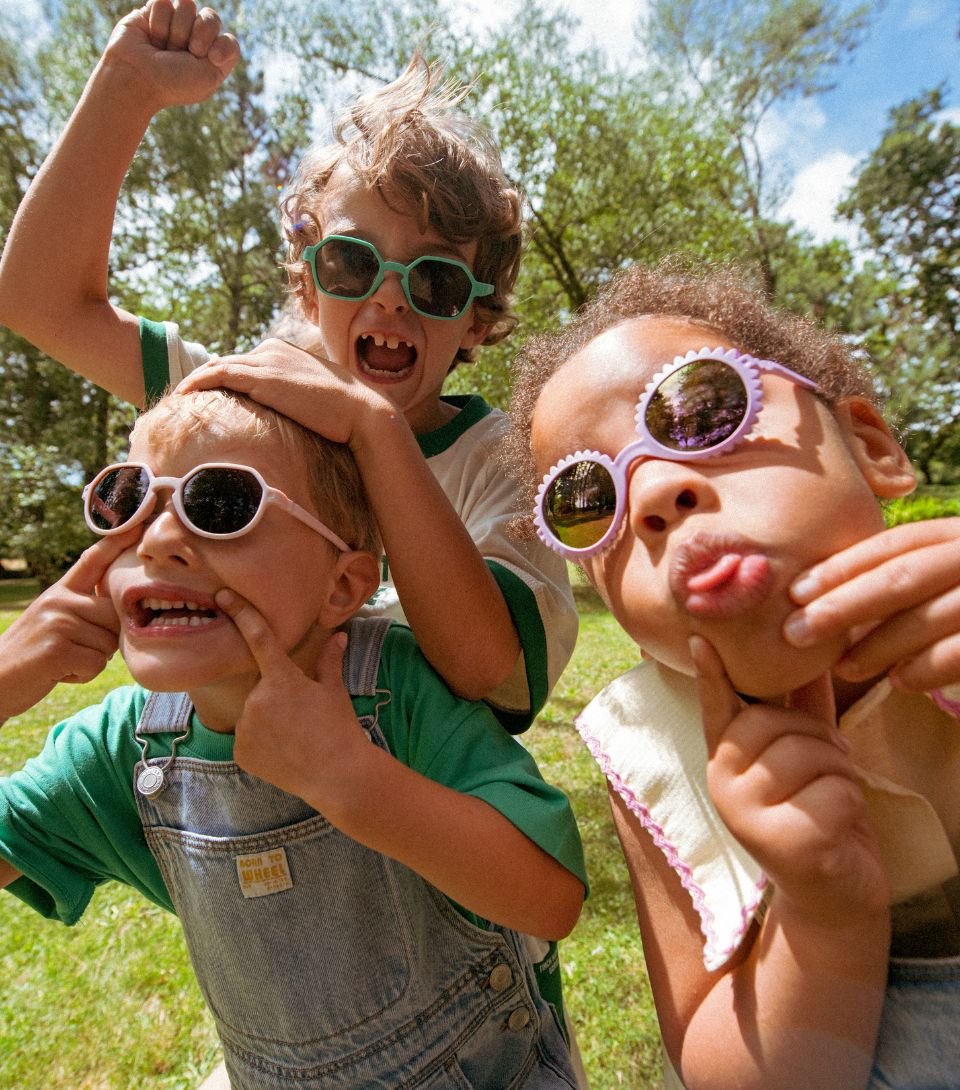
We recommend letting your child choose the color and/or shape they prefer. Indeed, when a child likes their glasses, they wear them with pride — and without fuss!
At Ki ET LA, the models are designed to be fun, comfortable, and stylish, from baby to pre-teen.
The importance of parental supervision
It is essential to regularly check the condition of the lenses. Indeed, scratches, impacts, or wear can alter the protection. If the lenses are damaged, they will no longer protect effectively. Therefore, you should think about replacing the glasses in case of breakage (or changing the lenses otherwise), or when they become too small.
Situations where wearing sunglasses is particularly recommended
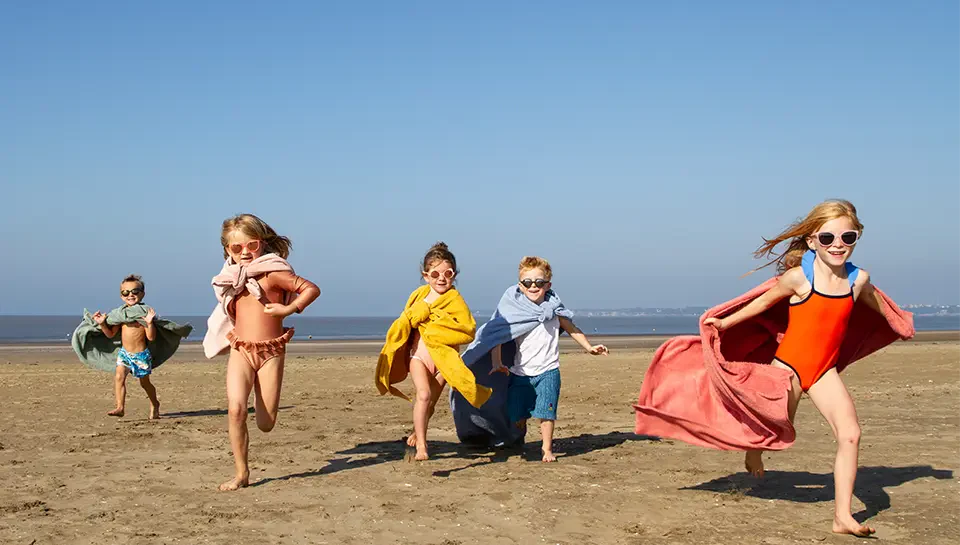
At the beach, in the mountains, by the water
Did you know that sand, water, and snow reflect up to 85% of UV rays?
- Up to 30% of UV rays are reflected by water
- Sand reflects up to 20% of UV rays
- Snow reflects up to 85% of UV rays

The eyes are then much more susceptible to damage in these conditions.
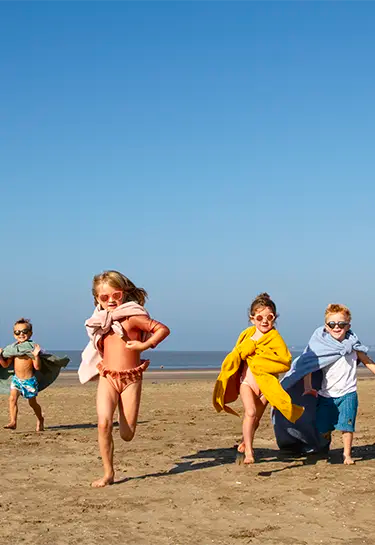
Even under a beach umbrella or on cloudy days, the eyes remain exposed. It is especially in these environments that you must redouble your vigilance.
During outdoor sports activities
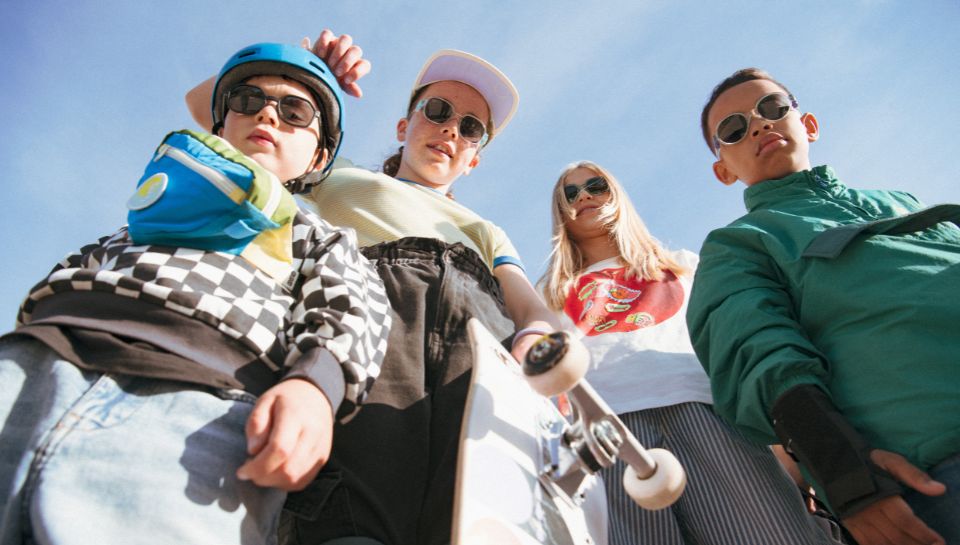
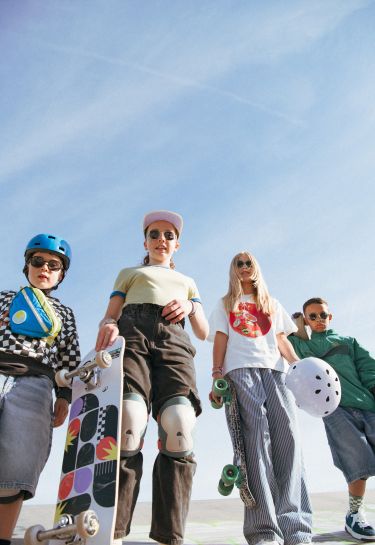
During outdoor activities, your child still needs to stay protected! Whether cycling, scootering, or playing in the park, the sun is always present.
Wearing sunglasses protects not only from the sun's rays but also from potential insects, tree branches, etc.
In sunny weather… even in winter
UV rays penetrate clouds and reflect off light surfaces. Similarly, exposure in the mountains during snowy periods can be even stronger than in summer.
This is why sunglasses should be a year-round reflex, not just during the summer!