




Summary:
- Understanding UV rays and their effects on babies' eyes
- The different protection categories for sunglasses
- Which UV category should you choose for baby's sunglasses?
- Safety tips for choosing the right baby sunglasses
- In summary
Protecting your baby's eyes from the sun is an essential reflex from the very first months of life. While sunscreen is a must for the skin, sunglasses are just as essential for the eyes. But between the different UV categories, lenses, frames, and tints, it is not always easy to choose the right model.
Here is a complete guide to understanding and choosing the most suitable UV category for your child — whether for a hike or a simple family outing in the family.
Understanding UV rays and their effects on babies' eyes
The different types of UV rays (UVA, UVB, UVC)
The ultraviolet rays (UV) are invisible to the naked eye, but their effects are very real.
-
UVA rays penetrate deep into ocular tissues and contribute to premature aging of the eye.
-
UVB rays are more energetic and can cause inflammation and eye burns.
-
UVC rays, absorbed by the ozone layer, fortunately do not reach us.
Why are babies' eyes so sensitive?
The eyes of babies are in full development:
-
Their crystalline lens is immature and lets in much more UV light than an adult eye.
-
Their natural filtration capacity is limited.
Result: prolonged contact with the sun, even if mild, can have long-term consequences on their vision.
The risks of exposure without protection
Without protection, children's eyes can suffer from:
-
Photokeratitis: a sort of "sunburn" of the cornea.
-
Retinal lesions caused by the reflection of light on sand or snow.
-
Early cataract, due to repeated contact with the sun from a very young age.
This is why wearing sunglasses adapted with the correct protection & UV index is essential.
The different protection categories for sunglasses
Sunglasses are classified according to 5 UV categories, numbered from 0 to 4. This classification determines their ability to filter visible light, as well as their effectiveness against UV.
Here is a table to better understand them:
| Category | Visible light filtration | Recommended use |
|---|---|---|
| 0 | 0 to 19% | Fashion or indoor use |
| 1 | 20 to 57% | Low light, cloudy sky |
| 2 | 58 to 82% | Average brightness |
| 3 | 83 to 92% | Strong sun: city, hiking, seaside |
| 4 | 93 to 97% | Extreme exposure: mountains, snow, sea |
To remember: the higher the UV index, the stronger the protection against light and UV rays.
Lenses and their role
The lenses of sunglasses for babies must block 100% of UV rays while offering an adapted tint.
-
Grey lenses preserve natural colors.
-
Brown lenses improve contrast, perfect for activities in bright sunlight.
-
Green lenses provide a good balance between comfort and color fidelity.
Ki ET LA products, designed in France, use unbreakable sun lenses to guarantee both safety and quality.
Special cases: sea, mountains, snow
High-reflection environments significantly increase the amount of light received by the eyes.
In these cases, category 4 is recommended: it offers the highest protection.
For daily use (city, walking, sport, etc.), category 3 is more than sufficient.
Which UV category should you choose for baby's sunglasses?
Recommendations for babies
For a baby, it is imperative to opt for category 3 or 4 protection depending on the environment:
-
Category 3: ideal for regular outdoor use, when brightness is strong without being extreme.
-
Category 4: perfect for activities with high exposure (beach, mountain reefs, snow).
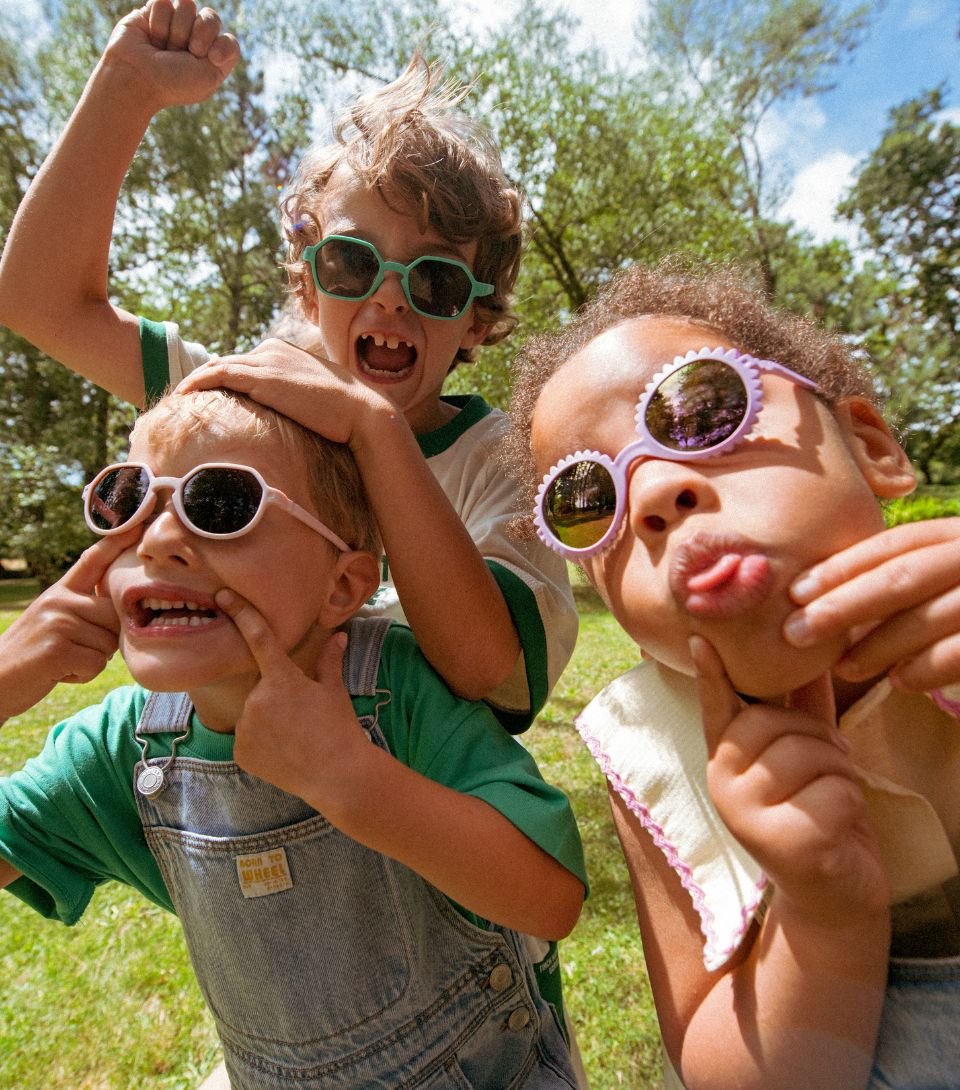
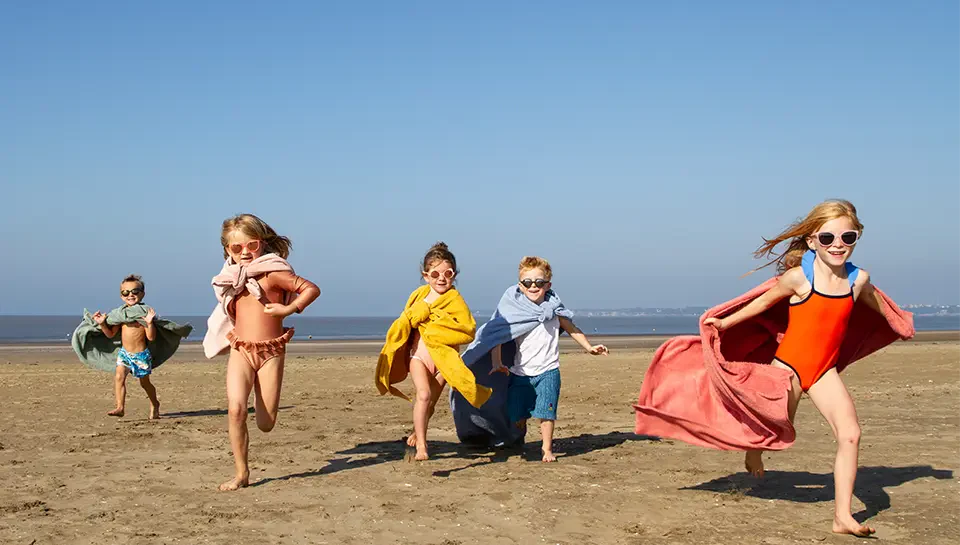
Ki ET LA glasses meet these protection criteria, while ensuring comfort and quality thanks to their flexible frames and flexible temples.
Adapting the choice according to the child's activities and age
-
In the city, for daily outings, category 3 is ideal.
-
At high altitudes, opt for category 4, because reflection can double the amount of UV rays received.
-
During a hike or outdoor sport, the glasses must be well-fitted, with a strap to keep the frame on the face.
The choice of UV protection must also take into account the age: the younger the children, the higher the protection must be.
The importance of an adapted frame
A frame also plays a crucial role; when well-designed, it protects not only the vision, but also the nose and sides of the face against indirect light.
The Ki ET LA frames, designed for babies, are:
-
Flexible, to avoid any discomfort.
-
Unbreakable, to withstand handling by little hands.
-
Lightweight, to ensure maximum comfort.
Some pairs include an adjustable strap, ideal for family games outside in the family.
Safety tips for choosing the right baby sunglasses
Before buying a pair of sunglasses for your child, ensure that:
-
The UV category is clearly indicated on the product.
-
The CE marking is present, guaranteeing European compliance.
-
The lenses are resistant, lightweight, and treated against glare.
-
The frame is bisphenol-free, phthalate-free, and adapted to the shape of the face.
-
The style and colors appeal to your daughter or son — because the best way to keep them on the nose is for the baby to love them!
Ki ET LA models combine design, sun protection, and comfort, while remaining affordable in price.
Furthermore, their manufacturing quality in France guarantees durable products, respectful of children and the planet.
In summary
Choosing the right UV category for baby sunglasses means giving their eyes optimal protection from a very young age:
-
Category 3 for daily sun exposure.
-
Category 4 for very bright environments (sea, mountain reefs, snow).
-
A frame adapted for comfort, safety, and style.
Ki ET LA sunglasses combine quality, design, and innovation, so that every baby can discover the world in the sun, safely… and with plenty of fun ☀️